A 2027 budget that depreciates every GPU over three years, because “GPUs obsolete fast,” is using a life none of the five filings below actually discloses for servers. Server useful life in the latest annual reports runs from Microsoft’s range of two to six years, through Meta’s band of five to 5.5 years, to a six-year life at Alphabet and at CoreWeave. Amazon moved a subset of servers and networking the other way in 2025, from six years to five, and told shareholders the shorter life raised depreciation by $1.4 billion.
Thesis: the depreciable life of AI servers is a disclosed accounting estimate, not a physical half-life, and the 2025 updates point in opposite directions. Meta lengthened most server and network lives to 5.5 years and reduced depreciation by $2.92 billion. Amazon shortened a subset and increased depreciation by $1.4 billion. A buyer who copies either number into a GPU business case without the word “subset” or “most” will misstate the annual charge by tens of thousands of dollars per million dollars of hardware.
The lives below are quoted from Form 10-K filings we opened for this article. The dollar-per-year figures on a $1,000,000 asset are straight-line arithmetic with zero salvage, computed by us, and labeled as such. They are not the companies’ depreciation expense. A server useful life taken from a peer is still an estimate, and the note that states it also states that the owner revisits it.
What the filings say the server useful life is
Meta’s Form 10-K for the year ended December 31, 2025 states that an assessment finished in January 2025 increased the estimated useful lives of most servers and network assets to 5.5 years, effective January 1, 2025. The property-and-equipment table as of December 31, 2025 still shows servers and network assets at five to 5.5 years. “Most” were extended. The table’s floor of five years is still in the disclosure, so the fleet is not a single 5.5-year asset. The filing does not print the life those assets had before the extension.
Amazon’s Form 10-K for the year ended December 31, 2025 states two changes. Effective January 1, 2024, Amazon changed the estimate for its servers from five years to six. Effective January 1, 2025, it changed a subset of servers and networking equipment from six years to five, and it says the shorter lives are due to the increased pace of technology development, particularly in artificial intelligence and machine learning. The word “subset” is load-bearing. The filing does not say the entire server fleet returned to five years.
Microsoft’s Form 10-K for the fiscal year ended June 30, 2026 says servers and network equipment are generally depreciated over two to six years, and software developed or acquired for internal use over three years. That range is the widest server useful life in this set. Alphabet’s Form 10-K for the year ended December 31, 2025 depreciates servers and network equipment generally over six years, and buildings over seven to 40 years. CoreWeave’s Form 10-K for the year ended December 31, 2025 lists technology equipment at six years, after a January 1, 2023 change from five years. None of these lines is labeled “GPU.”
| Company | Period | Asset description in the filing | Disclosed life | 2024–2025 change the filing states |
|---|---|---|---|---|
| Microsoft | Year ended June 30, 2026 | Servers and network equipment | 2 to 6 years | None stated in the useful-life paragraph |
| Amazon | Year ended Dec. 31, 2025 | Servers; a subset of servers and networking | 6 years, then 5 for a subset | 2024: servers 5 → 6 years. 2025: a subset 6 → 5 years |
| Meta | Year ended Dec. 31, 2025 | Servers and network assets | 5 to 5.5 years | January 2025: most assets increased to 5.5 years |
| Alphabet | Year ended Dec. 31, 2025 | Servers and network equipment | Generally 6 years | No change stated in the property note |
| CoreWeave | Year ended Dec. 31, 2025 | Technology equipment | 6 years | January 2023: computing equipment in data centers 5 → 6 years |
Source: Form 10-K filings of Microsoft, Amazon, Meta, Alphabet, and CoreWeave, property-and-equipment notes, retrieved October 2, 2026. Takeaway: the disclosed band for server-class assets is 2 to 6 years, and the two 2025 revisions moved in opposite directions.
The straight-line charge on one million dollars
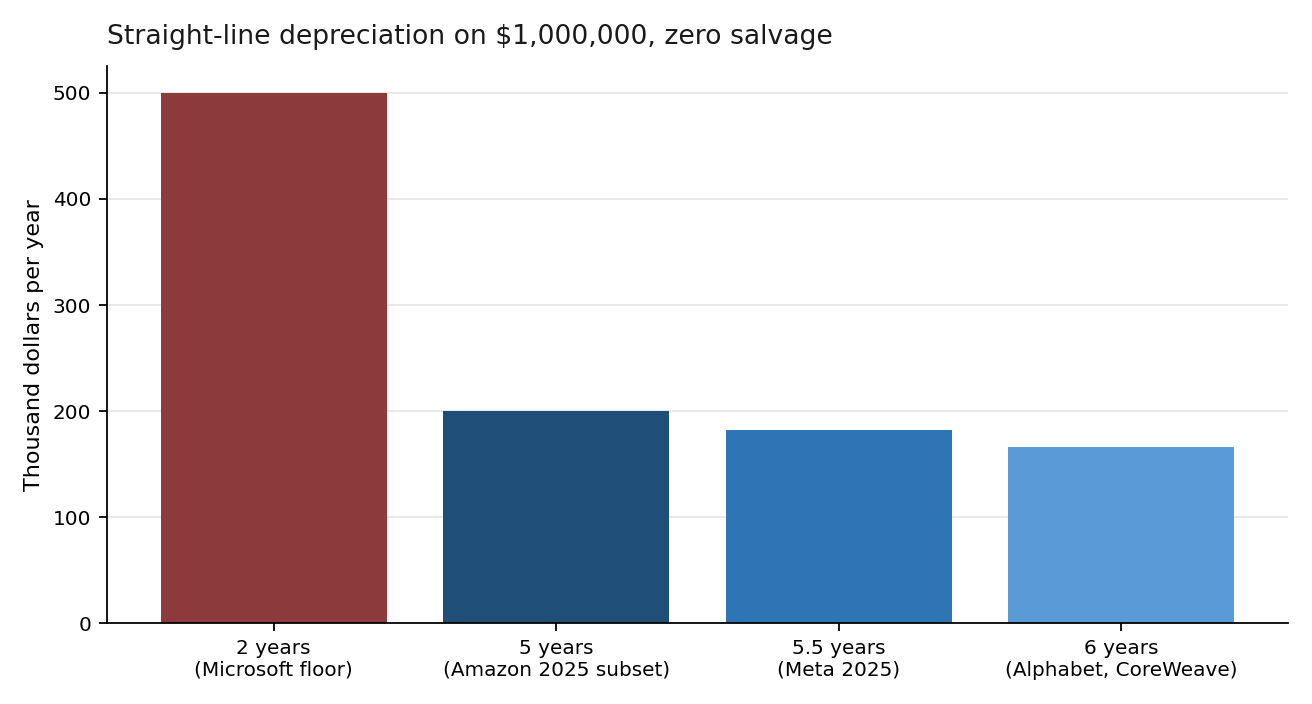
Straight-line depreciation with zero salvage is cost divided by life. On $1,000,000 that is $500,000 a year at two years, $200,000 at five, $181,818.18 at 5.5, and $166,666.67 at six. The two-year charge is exactly three times the six-year charge, because 1/2 divided by 1/6 is 3. Moving from six years to five years adds $33,333.33 a year. Moving from six years to 5.5 years adds $15,151.52 a year.
Those four rates are the decision content of the filings. A finance partner who books a GPU server at Microsoft’s floor (two years) will expense it three times as fast as a partner who books the same invoice at Alphabet’s general six-year life. Nothing in the silicon changed. The estimate changed. Salvage value, if the contract assumes a resale, lowers every one of these charges. None of the five notes gives a GPU-specific salvage percentage, so this model uses zero and says so.
The same arithmetic shows why a single “AI GPU life” plugged into a cluster TCO model dominates the answer. On a $50 million hardware line, the annual gap between five years and six years is 50,000,000 × (1/5 − 1/6) = $1,666,666.67 a year, before tax. That figure is our scaling of the $1,000,000 case. It is not a number any company reported.
| Life | Annual charge | Annual rate | Where that life appears |
|---|---|---|---|
| 2 years | $500,000.00 | 50% | Microsoft floor for servers and network equipment |
| 5 years | $200,000.00 | 20% | Amazon’s 2025 subset; Meta’s disclosed floor |
| 5.5 years | $181,818.18 | 18.18% | Meta, most servers and network assets, from January 1, 2025 |
| 6 years | $166,666.67 | 16.67% | Alphabet generally; CoreWeave technology equipment; Amazon servers after the 2024 change and before the 2025 subset |
Source: lives from the Form 10-K notes; annual charges computed by GPU Insights as 1,000,000 divided by life. Takeaway: five years costs $33,333 more per year than six years on each million dollars of cost.
What the companies said the estimate did to earnings
Meta quantifies its extension. Based on servers and network assets placed in service as of December 31, 2024, the change reduced depreciation expense by $2.92 billion and increased net income by $2.59 billion, or $1.00 per diluted share, for the year ended December 31, 2025. The $0.33 billion difference between those two disclosed figures is the gap in the filing between pre-tax depreciation and after-tax net income. We did not estimate a tax rate.
Amazon quantifies the shortening. For the year ended December 31, 2025, including servers and networking equipment that were on the books at December 31, 2024 and those acquired during 2025, the change increased depreciation and amortization by $1.4 billion and reduced net income by $1.0 billion, or $0.10 per basic share and $0.10 per diluted share, primarily in the AWS segment. The $0.4 billion difference between the depreciation increase and the net-income decrease is likewise the gap between the two figures Amazon printed.
CoreWeave quantified an older change, and the scale is a warning against mixing eras. The move from five to six years, effective January 1, 2023, reduced total expenses by $20 million for the year ended December 31, 2023, and increased earnings per share by $0.10 that year. That was a much smaller asset base. It is not a 2025 earnings bridge. Microsoft and Alphabet do not, in the passages above, attach a dollar effect to a 2025 life change.
A gross book balance is not a GPU inventory
Microsoft’s property note, in millions, shows servers, network equipment, and software at a gross carrying amount of $215,874 million on June 30, 2026, against $132,836 million a year earlier. The gross balance rose by $83,038 million. That line includes software, whose disclosed life is three years, and servers, whose disclosed life is two to six years. Dividing $215,874 million by any single life produces a fake depreciation number. We do not do it.
CoreWeave is the filing in this set that actually sells GPU capacity, and even there the life is “technology equipment,” not a named GPU generation. As of December 31, 2025, CoreWeave reported 43 data centers, over 850 MW of active power, about 3.1 GW of contracted power, and $60.7 billion of remaining performance obligations, up from $15.1 billion a year earlier. Committed contracts had a weighted-average duration of approximately five years. Technology equipment is depreciated over six years. The average contract is shorter than the book life. If the hardware cannot be redeployed after the contract, the remaining book value is the risk CoreWeave describes when it says a wrong useful-life estimate can affect results. That is a disclosure, not a forecast that the hardware will be idle.
Contract structure around that risk is covered in the enterprise GPU procurement playbook. The electricity to run the same asset is a separate operating cost, covered in the power-infrastructure analysis. Depreciation does not include watts.
Worked example. A buyer capitalizes $1,000,000 of server equipment. Booked at six years, year-one depreciation is $166,666.67. Booked at five years, it is $200,000.00. The cash invoice did not change. Over the first year the five-year policy expenses $33,333.33 more. That is 20 percent more than the six-year charge, because the rates are exactly 1/5 and 1/6. A lender who covenants on EBITDA will see a higher EBITDA under the longer life, by that $33,333.33, because depreciation is added back. A tax department may not follow the book life at all. The worked example is book depreciation only.
The counterargument: accounting life is a fiction, so use three years
Platform teams often keep a planning life near three years because a new GPU generation arrives about that often and the old card loses the software race. Microsoft’s range includes lives as short as two years, so a short planning life is inside at least one disclosure. Using three years for a decision model is not prohibited by these filings.
It is a different number from the number the hyperscalers are using for most of the fleet they just lengthened or held at six years. Amazon’s 2025 shortening is the counterexample, and it is explicitly tied to AI, and it is explicitly a subset. Copying Amazon’s five years onto an entire cluster, or copying Meta’s 5.5 years onto a GPU that the filing never names, both over-read the note. The defensible internal policy is a life inside the disclosed band, a salvage assumption written in the same sheet, and a sentence that says the life is an estimate. Three years is $333,333.33 of depreciation per million dollars per year. That is our arithmetic (1,000,000 / 3). It is not a sixth filing.
What this analysis can’t tell you
It cannot tell you the useful life of an H200, a B200, or an MI355X. No filing in this set isolates GPUs from CPUs, networking, or, in Microsoft’s case, software. It cannot tell you Meta’s pre-2025 life; the 10-K states the destination, 5.5 years, and not the prior figure. It cannot tell you tax depreciation, lease accounting, or residual value in a particular contract. CoreWeave’s $0.10 per-share effect is a 2023 figure. Amazon’s $1.4 billion is the effect of a subset, for one year, on assets already owned plus those acquired in 2025, not a run-rate for 2027 purchases.
Oracle is absent. A download of the Oracle annual report path we tried returned a 404, so Oracle’s life is not in this comparison. Lives change. These are the notes as filed for the periods named, read on October 2, 2026.
When to lock a server useful life for the 2027 budget
If the asset is a mixed server-and-network purchase and the owner reports under U.S. GAAP, the disclosed peer band is two to six years. A policy outside that band should explain why. If the hardware is expected to leave service with the first contract, CoreWeave’s own pair of numbers is the caution: about five years of weighted-average committed duration against a six-year technology-equipment life. Set the planning life at the contract if you cannot show a second deployment.
A controller aligning to Meta’s 2025 action uses 5.5 years for assets that match “most servers and network assets,” and keeps five years available because the table still says five to 5.5. A controller aligning to Amazon’s 2025 action applies five years only to the slice of the fleet whose technology cycle actually shortened, and leaves the rest at the prior estimate. A FinOps lead feeding a cost-per-token model should show the annual depreciation both at five and at six years, because that $33,333 per million dollars is larger than many of the price gaps those models argue over. A procurement lead comparing a capital purchase with a rental or custom-silicon commitment should not treat a six-year book life as evidence the card will be competitive for six years.
FAQ
How long do hyperscalers depreciate servers?
In the filings read for this article, Alphabet says generally six years for servers and network equipment. Meta says five to 5.5 years, with most assets at 5.5 years from January 1, 2025. Amazon says it moved servers from five to six years in 2024, then moved a subset back to five years in 2025. Microsoft discloses a range of two to six years rather than a point estimate.
Did Amazon shorten GPU lives?
Amazon said it shortened the useful lives of a subset of servers and networking equipment from six years to five, effective January 1, 2025, citing AI and machine learning. The note does not name a GPU product. The effect it does name, for 2025, is $1.4 billion of additional depreciation and $1.0 billion less net income, primarily in AWS.
Why did Meta’s longer life increase earnings?
A longer life spreads the same cost over more years, so the current year’s depreciation falls. Meta says the January 2025 change reduced 2025 depreciation by $2.92 billion and increased net income by $2.59 billion, or $1.00 per diluted share, measured on assets placed in service as of December 31, 2024.
Can I depreciate a GPU over three years?
Three years sits inside Microsoft’s disclosed range of two to six years and outside the point estimates Alphabet, CoreWeave, and Meta highlight. On $1,000,000 and zero salvage, three years is $333,333.33 of book depreciation a year. Whether a specific asset qualifies is an accounting judgment these filings do not make for you.
Does a longer book life mean the GPU stays fast?
No. Useful life in these notes is the period over which the owner expects to obtain economic benefit, reviewed for obsolescence. Amazon cited faster AI development as the reason to shorten a subset. The life is an estimate about use, not a benchmark result.
Sources & further reading
- Meta Platforms, Inc., Form 10-K for the year ended December 31, 2025
- Amazon.com, Inc., Form 10-K for the year ended December 31, 2025
- Alphabet Inc., Form 10-K for the year ended December 31, 2025
- Microsoft Corporation, Form 10-K for the fiscal year ended June 30, 2026
- CoreWeave, Inc., Form 10-K for the year ended December 31, 2025
Related reading
- GPU cluster TCO, on-premise versus cloud
- Enterprise GPU procurement playbook
- Custom AI silicon versus GPU rental
- H200 vs B200 vs H100 cost per token
- AI data center power infrastructure
Updated: October 2026. This page quotes accounting estimates from public annual reports and recomputes straight-line depreciation under stated assumptions. It is not an audit, a tax opinion, or a prediction of residual GPU value.

Author: Iovanny Olguín Ávila
Computer Systems Engineer with an MSc in Computer Science. I apply quantitative analysis and data-driven methodologies to evaluate financial instruments, investment vehicles, and emerging technologies. My technical background allows me to cut through marketing language and analyze the actual mechanics of financial products — from HELOC structures to Medicare Advantage plan design to business credit card reward algorithms.